Metropolitan tourism activities are shopping, sightseeing in big cities and enjoying modern amusement parks. The nation's capital, Jakarta, offers many places for shopping. Mal Kelapa Gading (the biggest one with 130,000 m²), Plaza Senayan and Plaza Indonesia are some of the malls in the city. Another popular tourist activity is golfing, a favorite sport among the upper classes Indonesian and also foreigners. Some notable golf courses in Jakarta are Cengkareng Golf Club, located in the airport complex, and Pondok Indah Golf and Country Club. Bali has many shopping centers, for instance, the Kuta shopping center and the Galeria Nusa Dua. Nightlife of Indonesia is also popular among foreigners, especially in the big cities like Jakarta, Bandung, Surabaya and Denpasar.[23]
Saturday, July 21, 2007
Metropolitan tourism
Metropolitan tourism activities are shopping, sightseeing in big cities and enjoying modern amusement parks. The nation's capital, Jakarta, offers many places for shopping. Mal Kelapa Gading (the biggest one with 130,000 m²), Plaza Senayan and Plaza Indonesia are some of the malls in the city. Another popular tourist activity is golfing, a favorite sport among the upper classes Indonesian and also foreigners. Some notable golf courses in Jakarta are Cengkareng Golf Club, located in the airport complex, and Pondok Indah Golf and Country Club. Bali has many shopping centers, for instance, the Kuta shopping center and the Galeria Nusa Dua. Nightlife of Indonesia is also popular among foreigners, especially in the big cities like Jakarta, Bandung, Surabaya and Denpasar.[23]
Cultural tourism
Main article: Culture of Indonesia
Indonesia consists of at least 300 ethnic groups, spread over a 1.8 million km² area of 6,000 inhabited islands.[1] This creates a cultural diversity, further compounded by Hindu, Buddhist, Islamic and European colonialist influences.
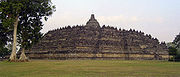
From the 3rd century until the 13th century, Hinduism and Buddhism shaped the culture of Indonesia. The best-preserved Buddhist shrine, which was built during the Sailendra dynasty in the 8th century, is Borobudur temple in Central Java. A few kilometers to the southeast is the Prambanan complex, a Hindu temple built during the second Mataram dynasty. Both the Borobudur and the Prambanan temple compounds have been listed in the UNESCO World Heritage list since 1991. In Bali, where most Hindus live, cultural festivals are major attractions to foreign tourists.
Islam has also contributed greatly to the cultural society in Indonesia. As of 2006, about 88% of Indonesians are Moslem.[21] Islamic culture is prominent in Sumatra, and a few of the remaining sultanate palaces can be seen in Medan and Pekanbaru.
Despite foreign influences, a diverse array of indigenous traditional cultures is still evident in Indonesia. The indigenous ethnic group of Toraja in South Sulawesi, which still has strong animistic beliefs, offers a unique cultural tradition, especially during funeral rituals. The Minangkabau ethic group retain a unique matrilineal culture, despite being devoted Muslims. Other indigenous ethnic groups include the Asmat and Dani in Papua, Dayak in Kalimantan and Mentawai in Sumatra, where traditional rituals are still observed.
A discussion of cultural tourism is not complete without a mention of Yogyakarta, a special province in Indonesia known as a centre of classical Javanese fine art and culture.[22] The rise and fall of Buddhist, Hindu, and Islamic kingdoms in Central Java has transformed Yogyakarta into a melting pot of Indonesian culture.
Volcanoes
Hiking and camping in the mountains are popular adventure activities. Some mountains contain ridge rivers, offering rafting activity. Though volcanic mountains can be dangerous, they have become major tourist destinations. Popular active volcanoes are the 2,329 m high Mount Bromo in the East Java province with its little desert, the upturned boat shaped Tangkuban Perahu on the outskirts of Bandung, the most active volcano in Java, Mount Merapi and the legendary Krakatau with its new caldera known as anak krakatau (the child of Krakatau). Puncak Jaya in the Lorentz National Park, the highest mountain in Indonesia and the only mountain with ice caps, offers the opportunity of rock climbing. In Sumatra, there are the remains of a supervolcano eruption that have created the landscape of Lake Toba close to Medan
National parks
The biggest national park in Indonesia is the 9,500 square kilometre Gunung Leuser National Park in the north of Sumatra island.[18] Together with Kerinci Seblat National Park and Bukit Barisan Selatan National Park, the total 25,000 square kilometres of national parks in Sumatra, named Tropical Rainforest Heritage of Sumatra, has been added to the UNESCO World Heritage list. Other national parks on the list are Lorentz National Park in Papua, Komodo National Park in the Lesser Sunda Islands and Ujung Kulon National Park in the west of Java.
To be noticed, different national parks offer different biodiversity, as natural habitat in Indonesia is divided into two areas by the Wallace line. The Wallacea biogeographical distinction means the western part of Indonesia (Sumatra, Java, Kalimantan) have the same flora and fauna characteristics as the Asian continent, whilst the remaining eastern part of Indonesia has similarity with the Australian continent.
Many native species such as Sumatran elephants, Sumatran tigers, Sumatran rhinoceros, Javan rhinoceros and Orangutans are listed as endangered or critically endangered, and the remaining populations are found in national parks and other conservation areas. Orangutans can be visited in the Bukit Lawang conservation area. The world’s largest flower, rafflesia arnoldi, and the tallest flower, titan arum, can be found in Sumatra.
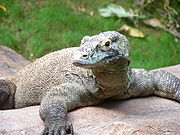
The east side of the Wallacea line offers the most unique and rarest and most exotic animals on earth.[19] Birds of Paradise, locally known as cenderawasih, are plumed birds that can be found among other fauna in Papua New Guinea. The largest bird in Papua is the flightless cassowary. One species of lizard, the Komodo Dragon can easily be found on Komodo, located in the Nusa Tenggara lesser islands region. Besides Komodo island, this endangered species can also be found on the islands of Rintja, Padar and Flores.[Nature tourism
Tourism in Indonesia
From Wikipedia, the free encyclopedia
Tourism in Indonesia is an important component of the Indonesian economy and an important source of foreign exchange revenues. With a vast archipelago of more than 17,000 islands,[1] the second longest shoreline in the world,[2] 300 different ethnic groups and 250 distinct languages,[3] and tropical climate throughout the year, nature and culture are two major components of Indonesian tourism.
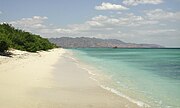
Tourism in Indonesia is currently overseen by the Ministry of Culture and Tourism. International tourist campaigns have been focusing largely on tropical destination with white sand beaches and blue sky imageries. Beach resorts and hotels were developed in some Indonesia islands, with Bali island as the primary destination. Cultural tourism is also an important part of Indonesia tourism industry. Toraja, Prambanan and Borobudur temples, Yogyakarta and Minangkabau are popular destinations for cultural tourism, apart from many Hindu festivities in Bali. About 5 million foreign tourists have visited Indonesia annually since 2000.[4]
However, tourism development had sometimes clashed with local people, that has created criticism over Indonesia's tourism industry. Most of the disputes were related over land possession, local traditions (adat) and the impact of tourism development to the local people. In another area, tourism industry in Indonesia faces major threats. Since 2002, several warnings have been issued by some countries over terrorist threats and ethnic/religious conflicts in some areas, which significantly reduces the number of foreign